
History
THE THREEPENNY OPERA
by Bertolt Brecht (Text) and Kurt Weill (Music) in collaboration with Elisabeth Hauptmann
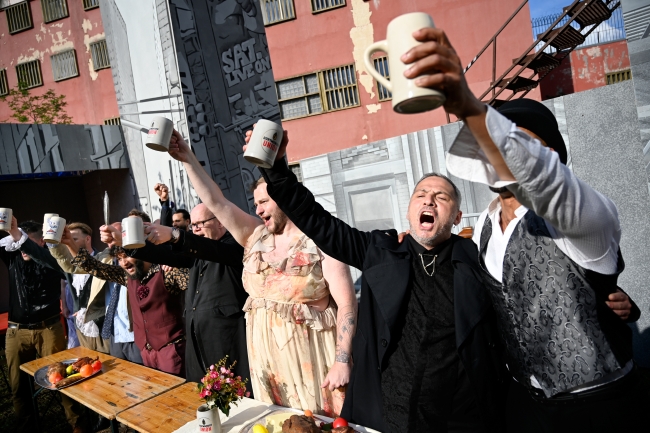
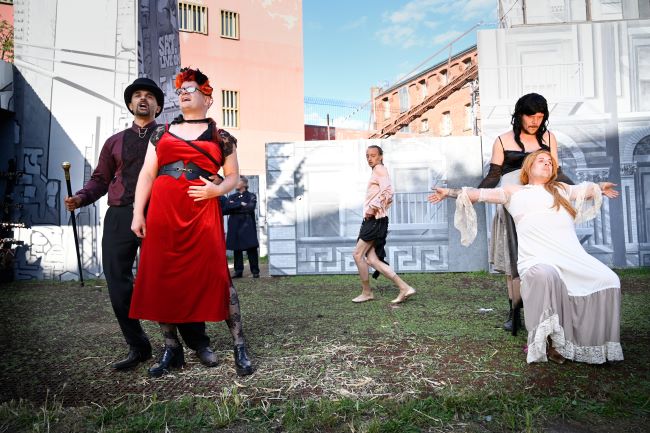
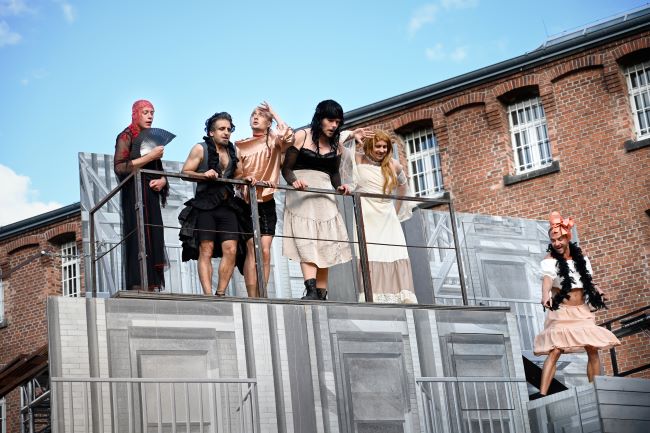
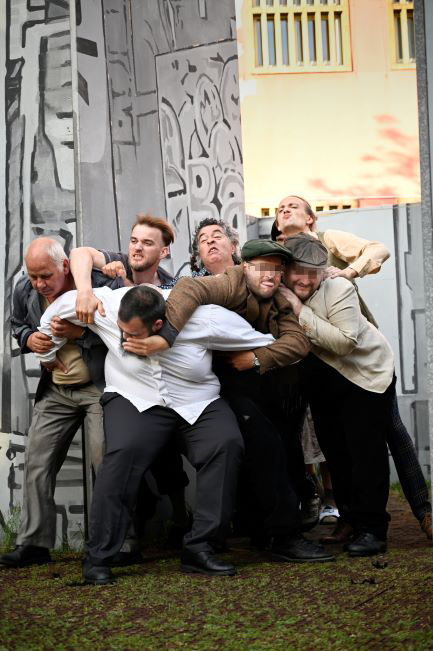
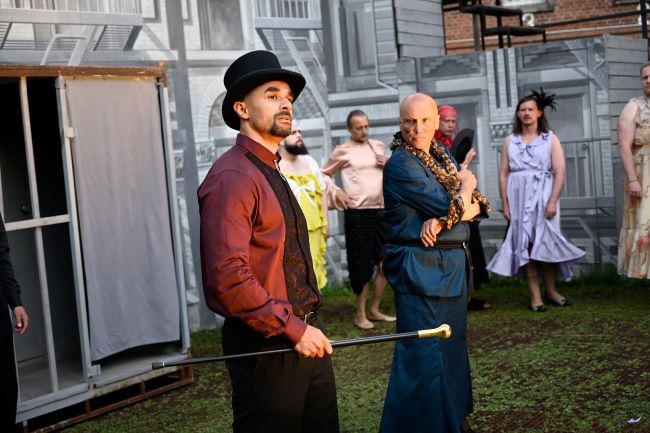
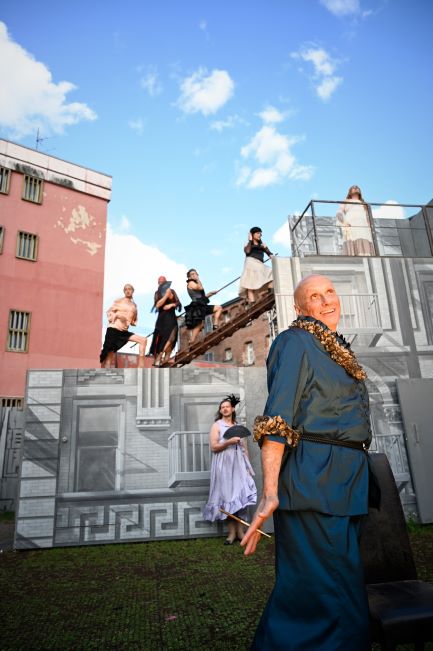
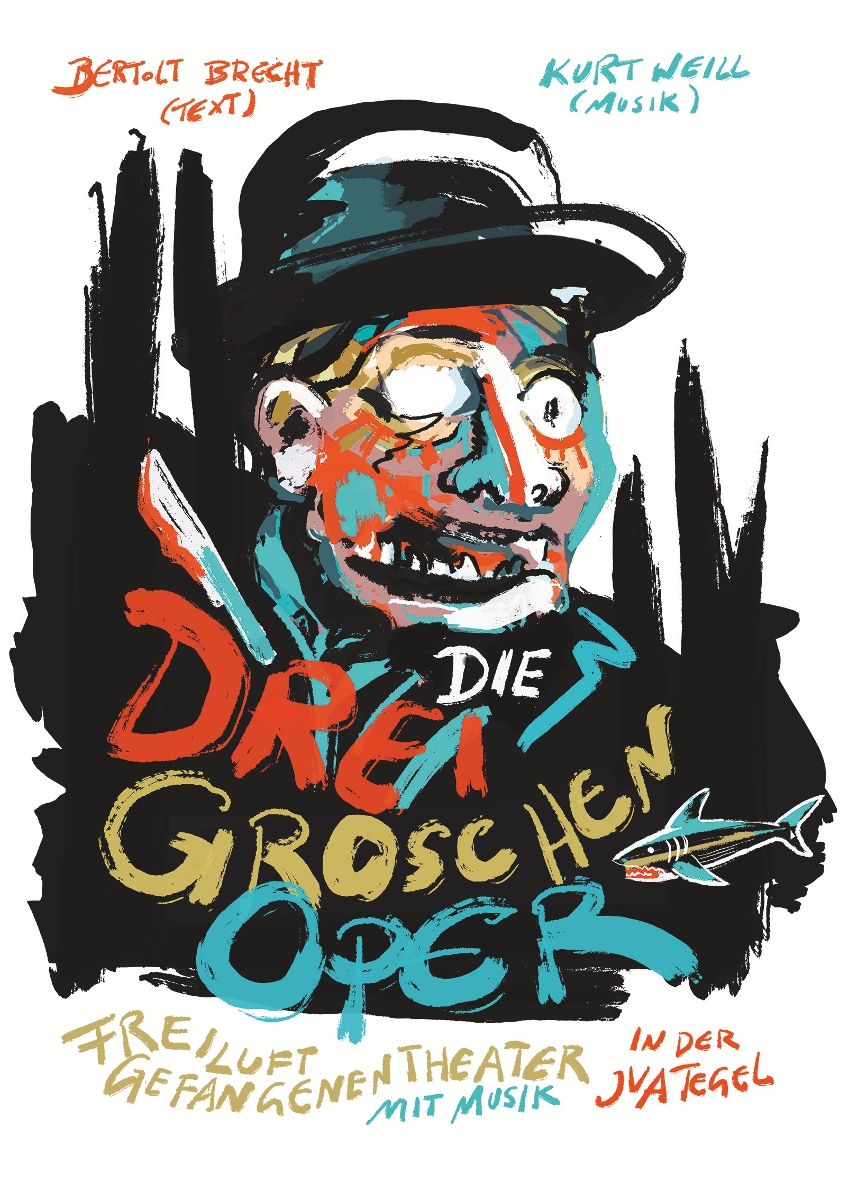
The Threepenny Opera is a theatrical sensation! Since its premiere in 1928, legends have surrounded the opera, which sent all of Berlin into a threepenny fever and gave Bertolt Brecht and Kurt Weill a global hit. Together with the prisoner ensemble of the Tegel Prison and five musicians from the 17 HIPPIES, aufBruch embarks on a journey into the depraved and sensual underworld of London, where gangsters, whores and thieves roam and Mackie Messer wreaks his respected and reviled havoc.
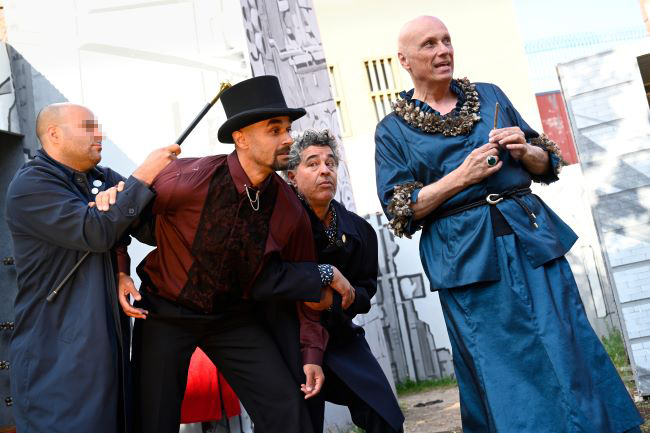
On the dark side of the dazzling metropolis of London, where the stench of corruption hangs in the air like a spectre, Mackie Messer goes about his robberies. His war comrade Tiger Brown, now promoted to police chief, backs him up, freely following the principle of one good turn deserves another. And Mac has bigger plans: he wants to go into banking. Just as corrupt as street robbery, but far more lucrative. When Mackie Messer chooses Polly Peachum as his bride, he attracts the attention of her father, the beggar king Jonathan Jeremiah Peachum. He is determined not to lose his daughter to this highwayman. Macheath's anarchic reign is threatened by the cunning machinations of his father-in-law, who has created an empire in which he uses military drill to lock the poor, the unemployed and the homeless into his system of exploitation. A battle ensues between the groom and his father-in-law, in which loyalties are put to the test and alliances crumble like sand.
The Threepenny Opera exposes the moral bankruptcy that lurks beneath the façade of bourgeois society. What is the difference between a street robber and a resourceful big businessman? In their symphony of the oppressed, Brecht and Weill paint a bleak portrait of a world in which compassion is a commodity and virtue a luxury that only a few can afford.
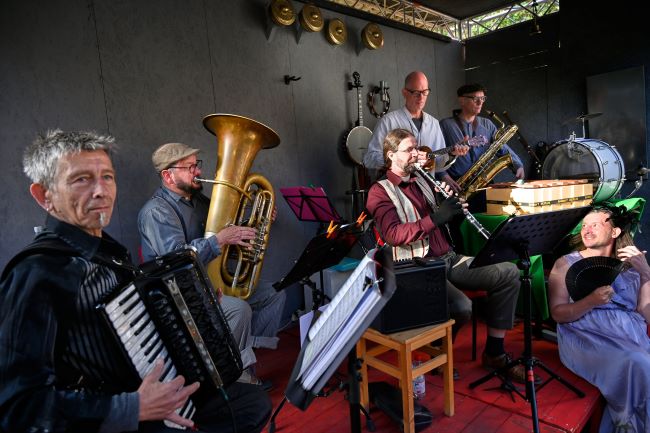
Almost 100 years later, the prison ensemble of the Tegel Prison is now searching for the relevance of Brecht's vision, accompanied by five musicians from the renowned Berlin band 17 HIPPIES, whose unique sound brings Weill's compositions to life for the first time in a prison exercise yard.
Because a shark isn't a shark unless you can prove it.
Performed by the Tegel Prison prisoner ensemble: Adrian U., Adrian Zajac, Atak, H. Peter Maier C.d.F., Horst Grimm, Jan M., Khaled H., Kristian, Marco, Mohammad Hassan, Muhammet, Norman, Paul E., Recep, Robin, Steffen Kahrels, Sven, Volkan, Yanne.
Accompanied by musicians from the 17 HIPPIES: Benjamin Ostarek (clarinet), Christopher Lastelle (banjo, percussion, ukulele), Orlando de Boeykens (tuba), Reinhard “Koma” Lüderitz (percussion, saxophone), Volker “Kruisko” Rettmann (accordion)
Director Peter Atanassow Stage design Holger Syrbe Costume design Anne Schartmann Dramaturgy Franziska Kuhn Musical concept and arrangements Christopher Blenkinsop (17 HIPPIES) Musical direction vocals Vsevolod Silkin Choreography Suzann Bolick Production management Sibylle Arndt Assistant director Nina Flemming Costume assistant Xijing Wang Production assistant David Donschen Technician Lilith Kautt Graphic Design Dirk Trageser.
Tickets: 18 € / 12 € (reduced)
Ticket sales start on Wednesday, 5 June 2024 at 3 p.m.
at the aufBruch-Onlineshop
or at the box office of the Volksbühne theatre on Rosa-Luxemburg-Platz
HINWEIS: Es handelt sich um eine Open-Air-Veranstaltung ohne Überdachung. Wettergerechte und warme Bekleidung ist unbedingt zu empfehlen!
Regenschirme sind auf dem Gelände der JVA nicht gestattet.
An open-air theatre production in collaboration with the 17 HIPPIES.
Funded by the Senate Department for Justice and Consumer Protection.
Supported by Tegel Prison.

Photos
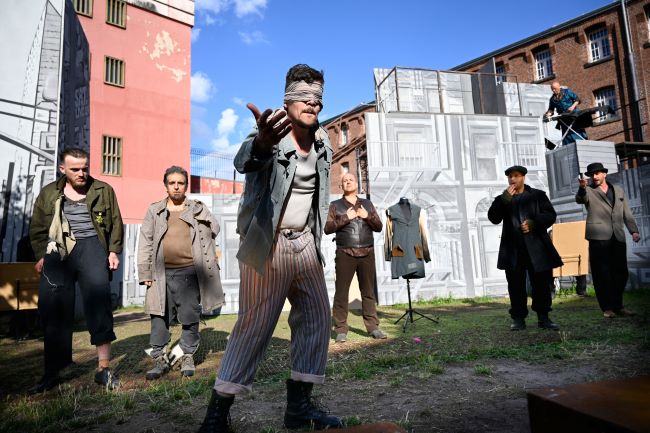
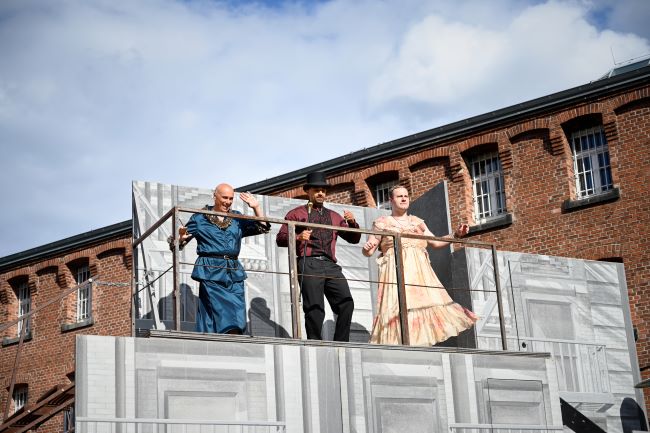
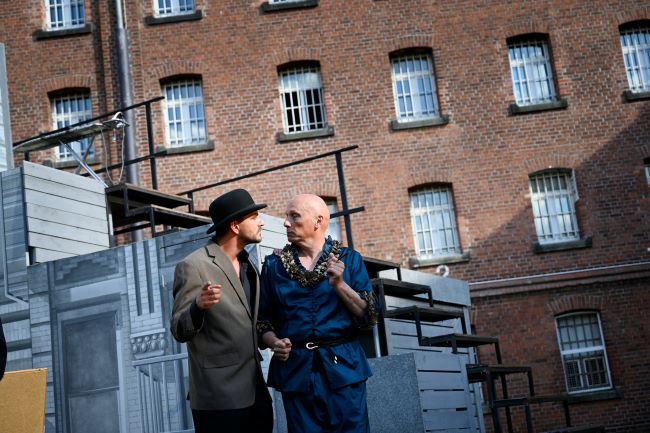
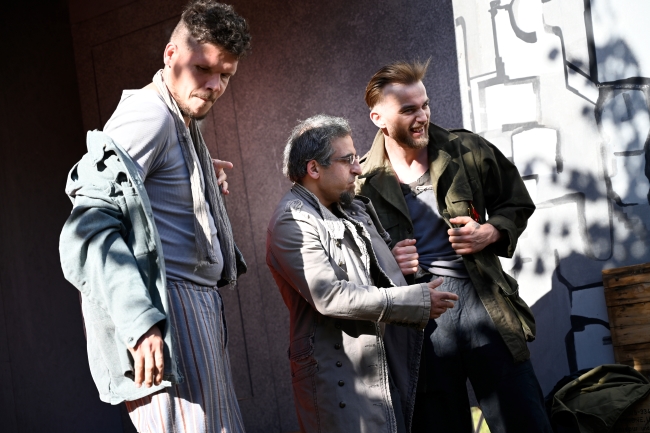
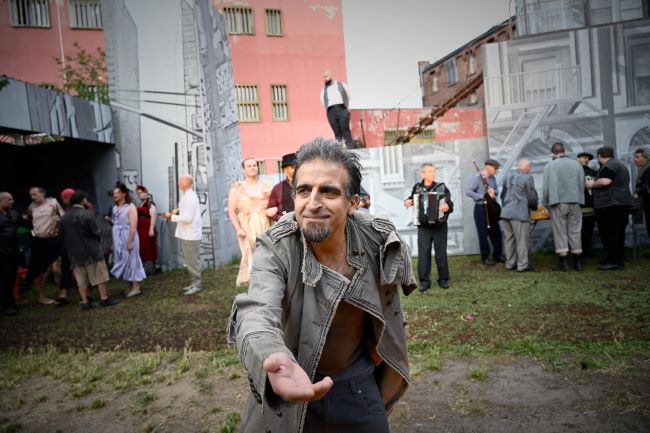
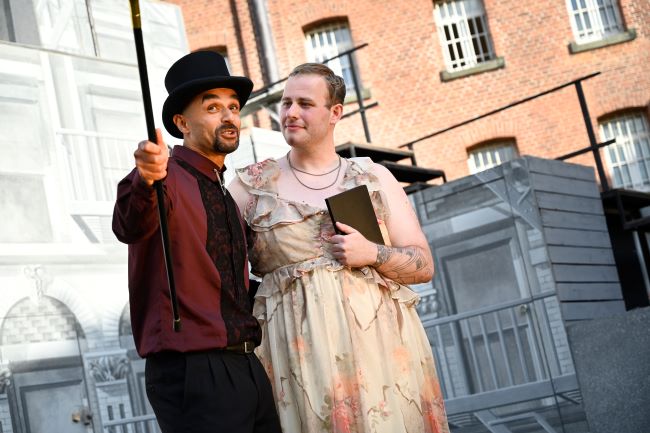
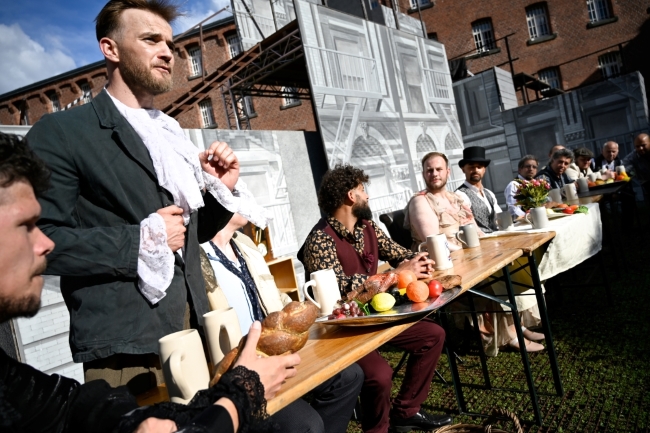
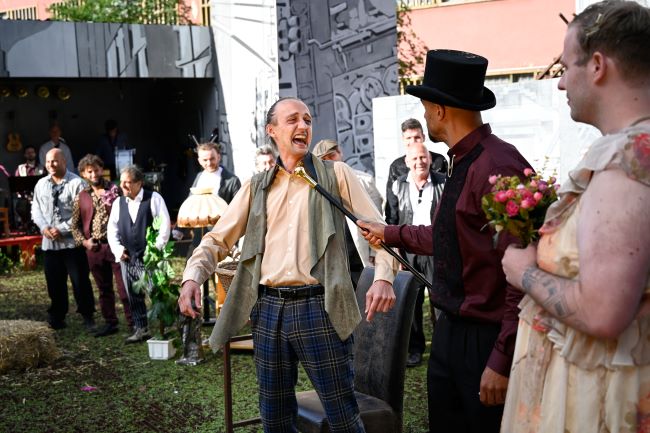

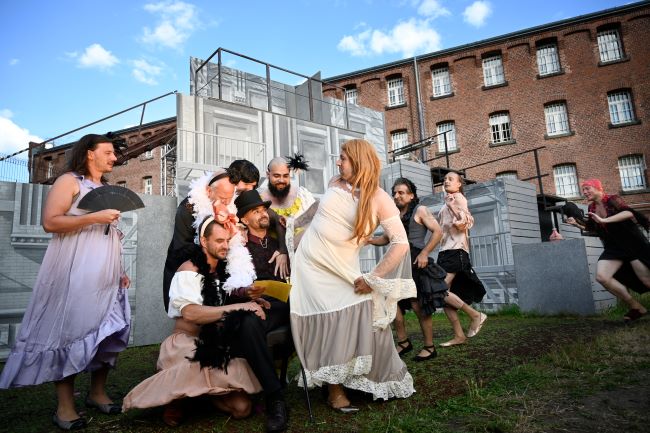
Photos: Copyright Thomas Aurin.
Any use only with the prior permission of aufBruch / Thomas Aurin
Press



In der Justizvollzugsanstalt in Berlin-Tegel leistet das Gefangenentheater aufBruch seit langem herausragende Arbeit. Jetzt hat der Regisseur Peter Atanassow mit dem Gefangenenensemble Brechts "Dreigroschenoper" inszeniert. Begleitet von Musikern der Berliner Band 17 HIPPIES. Ein Besuch.
von Janis El-Bira

„Dreigroschenoper“ im Gefängnis: Mit Eisenhämmern Fressen einschlagen
Die Botschaft der „Dreigroschenoper“ von Bertolt Brecht und Kurt Weill ist heute nirgends so gut und sicher aufgehoben wie in der JVA, vorgetragenen von Insassen. Die Kritik.
"Hier verliert die Londoner Bettleroper jeden kulinarischen und bürgerlichen Zynismus, wie er sich nicht vermeiden lässt, wenn die Kurt-Weill-Hits und die Brecht-Pointen im institutionalisierten Bühnen perlen. Hier im Knasthof, mit Hingabe vorgetragen von Insassen, verliert der Text von Moral, Unterdrückung und Klassenkampf jede Schmunzel-Ironie. [...]
Es kann aber nicht nur an dem Rahmen liegen, dass diese Aufführung das Stück in einer seltenen Weise stringent und sortiert durcherzählt. Eine klare firlefanzfreie Sache, deren Wahrheit ganz ohne doppelten Boden auskommt, deren Wahrheit so dingfest ist wie Gitterstäbe und die so schneidet wie eine Eisensäge."
von Ulrich Seidler




Das Berliner Gefängnistheater »aufBruch« inszeniert Brechts »Dreigroschenoper« in der JVA Tegel
von Erwin Grave

Performance venue:
Justizvollzugsanstalt Tegel - Freistundenhof der ehemaligen TA III
Seidelstraße 39
13507 Berlin
Entrance via GATE 2
How to get there:
U-6 Otisstraße or Holzhauserstraße